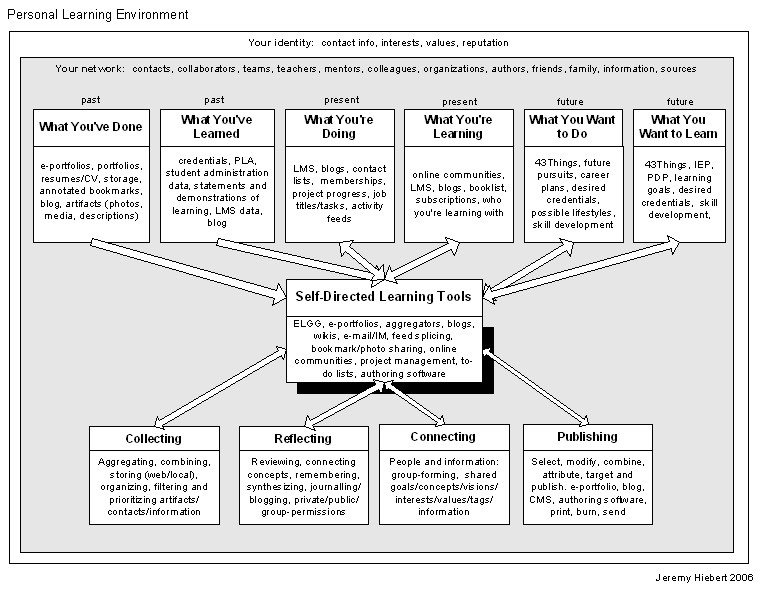
Participants thoughts of PLEs
- All of my resources, tools, communities, and networks that I learn with every day.
- the tools, people, resources that I cultivate to create a learning ecosystem
- A self-created collection of resources and people
- Whatever in my environment supports learning
- what I lose when the web goes down
- The tools I use to connect to all "my twitter connections" and how I save that information
- A combination of tools, services and resources everyone uses in the process of personal knowledge garden.
What are the problems that PLEs solve?
- PLE captures the creative tension between individual & system
- The learning I want is scattered everywhere an the PLE is my collection of knowledge/artifacts I want
- Helps to organize the chaos of what I find interesting
- Connect the dots in my learning
- Lifelong learning
- Nearer to the "normal" ways of learning
- Build upon ideas earlier and provide feedback
- Captures the creative tension between individual and system
- PLE transverse the Silo effect
Participant thought - "A PLE provides a way to think about how learning is happening to me. I don't have to be here to learn. I choose to be here. I choose the tools I want to use here. A PLE let's be approach the learning in a what that is physically and mentally occurring in similar ways."
MOOC - demonstrates the incoheresion that exists in learning
BrainySmurf:
- organizing the chaos (or info tsunami (Dec 23, 2004) as Jay Cross calls it) is so vital to my daily life now
- seems to me what's really new and pervasive now is access to multiple sources of info rather than "one source" (teacher/expert)

Within your environment you analyzing items (learning elements) as they come in and you aren't just remembering and aggregating them, but you are recognizing patterns and you develop your own "categorizing" of forms, rules, similarities, and principles" between all the items that come in. You are performing a cognitive task.
This pattern creation explains what I have been doing (in my opinion) when I collect info from my social networks and collect it into EVERNOTE. I seem to be able to retrieve the info even though I have thousands of items collected because of the patterns I have developed. Didn't know until now...this is how I was doing it.
Tracy Parish: This pattern creation explains what I have been doing (in my opinion) when I collect info from my social networks and collect it into EVERNOTE. I seem to be able to retrieve the info even though I have thousands of items collected because of the patterns I have developed. Didn't know until now...this is how I was doing it.
Lisa M Lane: the further I go into pattern recognition/creation, though, the more I lose my control of the specific content - I often can't find it again
Moderator (George Siemens): Here's a short post on how I manage information: https://landing.athabascau.ca/pg/blog/gsiemens/read/19803/how-do-you-manage-your-information
and more about "narratives of coherence" http://www.connectivism.ca/?p=220
Jenny Mackness: "Worried about "knocking" teachers, many are very talented and are working against the constraints of systems and are being brilliant in the way they are doing it."
Moderator (George Siemens): RESPONSE - the more structure a system the more tasks and roles required. This creates "we have to do it this way". The old way is a good structured teacher with good outcomes gets the acknowledgement first.
Moderator (George Siemens): http://jennymackness.wordpress.com/2011/02/25/attacks-on-connectivism/
Moderator (Stephen Downes): The Role of the Educator: http://www.huffingtonpost.com/stephen-downes/the-role-of-the-educator_b_790937.html
Tracy Parish: Great post from Thomas Baker in conjunction to Stephen's Huffington post http://profesorbaker.wordpress.com/2011/01/31/23-educator-roles-an-imagined-interview-with-stephen-downes-cck11/
What do we need to be aware moving forward with PLEs?
- Transient of service
- If Evernote shut down, I might have to die
- You need a back up plan
- Informal and formal identity as official practitioner
- No concerns, what you forget, was not important
- Contrived PLEs when they are taught out of context
- Where is the teacher in a PLE
- Multiplicty of services
- If Internet fails, we would revert to old model of ed
- Getting my stuff out of the PLE
- Is PLE only an online environment
- What are pedagogical implications of PLEs for our learning practices in the era of network
- Institutionally difficult to support chaotic
- Validation of the content that is out there
- Getting children to learn the basics, before setting them free to learn

Cris2B: I don't think we'd be talking about PLEs today if Web 2.0 had not opened up the Internet
Moderator (George Siemens): Web 2.0 opened access to the net, made it more accessible to all, but closed it as well. Far easier to create an account in Facebook then it is sometimes to create a WordPress blog. Not open in terms of "free speech."
keith.hamon: Interesting link about effort to create a distributed network: http://emergentbydesign.com/2011/02/22/towards-a-distributed-internet/
Moderator (Stephen Downes): Connecting one account to others is difficult. Facebook is doing this well though.
Moderator (George Siemens): The connections are what created value in PLEs. The knowledge is created by the connections at a minimum. Everytime Facebook manages to link to something else it gets users more integrated, more "locked in" or "invested into" the service. Moderator (Stephen Downes): a 'connective lock-in'
Moderator (Stephen Downes): There is zero support for a PLE out there because there are so many players who want to *own* the connections.
The knowledge is the connection. If Facebook is the connection, it owns the knowledge and ownership of the connection is everything is this present society.
Lisa M Lane: ownership of the means of connection






 Posts
Posts