Showing posts with label Stephen Downes. Show all posts

Sunday, 27 February 2011

Having Fun with Connectivism - #CCK11

Having some fun searching through the internet I came across a page that let's you find the shortest number of clicks from one Wikipedia article to another.  The example starts with Kevin Bacon to AI - 3 Clicks.

So I tried: Kevin Bacon to Connectivism - 5 Clicks
Kevin BaconChristmasGerman language-ismList of belief systemsConnectivism
I tried Kevin Bacon to George Siemens - 5 clicks because it includes the 4 clicks below:

To get from Kevin Bacon to Stephen Downes
Kevin BaconChicagoPublic Radio InternationalHistory of podcastingStephen DownesGeorge Siemens

and only 3 clicks to get from Stephen back to Kevin.

Stephen Downes
1959July 8Kevin Bacon
Oh the joys of Sunday afternoon.

Sunday, 6 February 2011

Thinking Inside of the Circle May Be Just What You Need

Okay, so the real saying is "Think Outside of the Box", but two postings I saw this recently were so far out of the box for me that I started to wonder if it's a way of thinking I can every accomplish.  Maybe my thinking is outside sometimes, but the real genius is inside the circle or tip-toeing around the triangle or maybe skipping around the hexagon.  Whatever the phrase might be, these two gentlemen displayed some great ingenuity.

Bruce Graham is one of these gentleman.  He's a frequent responder in the Articulate Community forum (a place where users of Articulate can gather help on the product in general, but more specifically on elearning design and delivery tips, tricks, and general idea sharing).  Recently someone (Jenise Cook) asked about her course on protecting your SIN#.  She was just looking for some different ways to perhaps present the material.  Various ideas were shared by a few different community members, but the one that stuck out for me was Bruce's.

His thought, which again I thought was brilliant, was to present the material back to the learner in a completely sarcastic manner.  In a way this would showcase to the learner that the main points of the lesson should be "so obvious" to the average user that there should be know doubt in their mind that they should know and remember this information.  The "over the top" course would reinforce the lesson, most likely, in a humoristic manner that would stick to the learner.


Identity theft is one of the fastest growing hobbies in America. Anyone who has your Social Security number can use it to get other personal information about you. But HEY!. That's OK - we're all friends here.  Lesson One - DO NOT MAKE EFFORTS TO PROTECT YOUR NUMBER


The lesson is filled with humour and sarcasm (maybe way I like it so much), but the overall summary or morale of each lesson is solid and factful.  A brilliant twist on a normal lesson delivery.  Spin the tale into a way the learner would never imagine.  Shock them with the material and it will stick.

The other example of ingenuity was from Thomas Baker (and if you haven't added his blog to your readings you should - an incredible and fun interactive teacher).  How much do you love this pic?
At Universidad de los Andes in Santiago, Chile. Thomas Baker having fun in class doing Limbo. Students waiting on their turn. (Source: La Tercera newspaper) via Final: The 80-20 Rule Re-Visited: Implications for Teacher Talking Time #ELTchat (blog posting)
His example to think differently about how to present material came from a posting he did on his blog 23 Educator Roles an Imagined Interview with Stephen Downes.  We've been taking CCK11 together this year and Stephen is one of the co-facilitators of the "course" (MOOC).  Thomas took an article (The Role of the Educator)  from the Huffington Post written by Stephen Downes and then re-wrote it into his blog as a series of questions and answers.  As if he was the one giving Stephen the interview.  Asking him questions of the material that was in the article and then using the article material as the answer to the question.

What a simple yet ingenious way to present material back to a learner in a different format.  It broke a long article in to manageable chunks.  It place that bit of human interaction back into what was just text and from, originally, one perspective.  More importantly it was well received by Stephen as well.

These two examples have me looking for more and more ways to think very differently about the way I would  like to present courses to learners.  Give them something they don't expect and look at the material from a completely different point of view.  I will be watching, reading and learning from these gentlemen for many years to come.  I thank them both for opening my mind to new and different possibilities.

Tuesday, 25 January 2011

Thoughts on Losing Waldo? - #CCK11

I was explaining to someone today about the idea that was raise in our online conversation last week, that knowledge is something that can't be unlearned.  As Stephen Downes explained, it's similar to looking at a "Where's Waldo" picture.  Once you know where he is, you always see him.  You can point to him in an instant and will be able to do so into the future.

This person at work looked at me, said "hmmmm, I'll need to think about that, I'm not sure I agree."  Stephen's explanation seemed completed logical to me and to many others in the class.

#cck11: Connectivism and Social Constructivism – what’s the difference? blog: Life through a Linz
Day 4: Where's Waldo? #CCK11 blog: Profesorbaker's Blog

(2008) Rehasing Old Tools to Look at CCK08 blog: OUseful.Info, the blog...

I'm curious to hear from anyone who perhaps didn't agree with this statement?  Please feel free to comment here:

Friday, 21 January 2011

Talking with George Siemens and Stephen Downes - CCK11 (week 1)

NOTES FROM:
First Facilitator Session - Review of Readings

 http://cck11.mooc.ca/week1.htm - "The Stephen and George Linkfest"

From George's first paper:
Connected specialization - "Store my knowledge in my friends".  I might not know how to do something, but I know who to call (connect to) that does have the answer.

Does Connectivisim entirely change the notion of expertise? - Stu Harris (cck11)
George's reply - a significant influence for sure.

What is the difference between "adaptive patterns" and "remixed prior knowledge"? - Jack Park (cck11)
  • Adaptive reveal our development over a period of time.
  • Over time you see how someone connects with others.
  • This might start to show how our patterns of knowledge develop. (e.g. many new inventions are combinations of other inventions - example the steam engine)
What connectivism claim in terms on knowledge construction that constructivism cannot? - Saadat (cck11)
  • Not all learning is acquisition. 
  • More organic growth of knowledge
  • New nodes are created and this can change the existing knowledge
  • Focus on the connection to understand knowledge develop
  • How we are connecting people and concepts
  • Seeing learning from the lens of connection and connection forming
  • "Explain what is the underlying biological pinning of other learning theories?"
"...not rejecting old theories, but how are you actually using them?" - Simon Fowler (cck11)
  • Some value in existing theories don't apply to the needs of people today
  • Determine what is learning and how does it actually occur

Jack Park "so you're saying they are the same. you appear to be saying that one builds on the other. so I'm interpreting the answer to say that connectivism builds on constructivism: not using the term "constructs" sounds a bit like wordsmithing -- don't mean to sound hostile, but everything that goes on in biological entities is anticipatory, whether constructed or not--at least, that's one view. I buy completely the renewed emphasis on relationships (connections)"
  • If we can understand the underpinnings of learning, how the brain itself produces similar connections, it tells us some level of synchronicity between these  (Olaf Sorns)
  • Sense that increasingly that the emphasis is shifting to a network assessment of learning.  Constructivism is very board umbrella.
Look back in 10 years time, and we will most likely realize we still don't have one theory that covers it all.  Can we find a more imperial basis of how people learn and in turn the best way to teach?

Stu Harris (cck11) - Connectivism makes it more difficult to continue the silos.

Keith Hamon (cck11) - The connection is the key. A single neuron knows nothing, contains no idea, only a pattern of interconnected neurons can generate knowledge

Meaningful way to connect knowledge?
  • We do need a base of knowledge to start with (George yes, Stephen perhaps no)
  • Listening to a good lecture is much like a good book (sometimes)
  • There is value sometimes, with some topics - exploration does not work.  Direct instruction is needed (eg. medical)
  • Experts can sense elements that novices can not. "intuition".  Not truly - fire example- it was too hot, too much water, too much etc.  The Expert could "see" the patterns, but the novice couldn't yet.
Overhead or skills necessary to truly utilize the tools in front of them?
  • George - Learning and learning innovations need to work within the reality of what is available
  • Stephen (perhaps) - ignore the system and do your own thing
  • Focus on teachers, focus only material, focus only learners....need to balance all
  • We don't yet have the tools to effectively learn in this setting, but we are getting there.
  • Need more tools that permit learners to learn without boundaries and barriers.  Need fluid interaction.
  • Barriers (time length, when, etc)
  • Learning implications of social interactions?

Can connectivism exist without the technology?
  • Yes constantly in a place of interacting with people with out technology
  • (view that language is not a technology though)
  • Treat the process of learning in social networks as a human attribute.
  • Technology advances those social interactions to a level beyond the one on one level.
Larry Kahn (cck11): Given the pace with which technology is evolving, how long do you think Connectivism will remain a valid theory?
Stu harris (cck11): @Larry  Doesn't the theory itself provide for its own evolution?

Stephen: Insofar as other theories are consistent with connectivism, they can be adopted... but where they differ, they should be corrected.

Language - is itself a network.  Meaning of any particular word, sentence, phrase, expression depends on a network of relationships with other words, sentences and phrases.
In connectivisim we take this seriously and this approach goes into the teaching and learning as well.  The meaning is embedded into this network.  Therefore the teaching of "facts" becomes more involved.  More where learning becomes embedded into this network as well.

Connectivism explained to an 8 year old? Linn (cck11)
  • You learn from your friends, but you don't take your friends word for eve5rything , you check things out for yourself and then share what you learn with your friends. (Stephen)
How to unconnect from connections that don't serve you well?
  • G -Not connect any more - starve a node (concept) that's not serving you any more.
  • G -Ie: Flat earth policy - how well is it integrated with your overall knowledge structure.
  • S - Ie learned racism to have yourself immersed in a world view, attitudes, beliefs, phrases, "dog whistles"(http://en.wikipedia.org/wiki/Dog-whistle_politics) this all together constitutes racism (works for biology, physics, math, etc).
  • S - You can't listen to it and turn it on or off at will.  Over time you gradually gather these items, you may decide to agree or disagree, but none the less you have learned something. 
  • S - Learning is natural, learning is something you do not matter what.  You're receiving input all day every day and this supports and creates learning.  Most is not purposeful.  Absorbing, understanding and adapting to environment.
  • G - Learning is absolutely constant
  • S - you have very very limited control over what you learned, but you have control over what you are exposed to.  You can try to resist (fire - if it touches you it will burn you). 
  • Nina (cck11): Link to Buddhism and Sufism, consciousness enables you to learn from every small experience and action.
  • S - Attentiveness to understand and experience something.
  • graemeferris (cck11): I find it useful to think about this in terms of the feedback mechanisms at work. Both positive and negative feedback mechanisms lead to learning
  • G - only physical or biological damage to your brain may effect learning
S - Flat earth - the power of a concept is how integrated it is into other perceptions of your life.

Saturday, 15 January 2011

Starting the Year off with #CCK11 - 'Connectivism' and Connective Knowledge

I walked into work yesterday and my co-worker told me how she had just signed up for 2 final courses she had been hoping to complete for the past year in order to complete her certificate.  I'm not sure which bulb went off in my head, or maybe the term should be which one went on, but I had the feeling come over me that I wish I was taking another course.

Then less then half and hour later I see on my Twitter feed from George Siemens:
We (@ and I) start CCK11 on Monday biggest change-no LMS (moodle). Sign up here: 
As soon as I saw the #CCK11 I knew exactly the course before even following the links.  This would be the Connectivism course facilitated by George and Stephen Downes.  I've looked into the course in past, but didn't think I had the time to commit to joining the extensive "conversation "this course will create.  So a little more digging and I think I've found what I might academically be looking for right now.

I suppose it felt like to many "signs" all appearing at once that I just couldn't pass up the opportunity to tap into a new learning opportunity.  Some of the faces in the class are ones that I have been communicating and learning from for quite some time.  So that feeling of first day of school and I don't know anyone is still there, but not nearly as bad as day 1 Grade 1.

My only challenge at the moment is getting registered.  It's amazing that this is a free MOOC (Massive Open Online Course), and I have registered online for the course.  However, if I can get a credit for it from University of Manitoba I'm going to and  there is the place that I'm currently having trouble registering.  It's my own fault leaving this to the last minute, but I did only find out about it yesterday.

So, here's to an exciting new learning adventure.  What a great way to start off a new year.

Friday, 12 September 2008

Learning Styles a Myth

I saw this on Brent Schlenker's post who got it from Clive Sheppard who got it from Stephen Downes and wanted to place it here purely for my own future reference. Please refer to their posts for more thoughts/comments.


I love that Brent pointed out that the video states the myth exists because we all believe that it does. I was just asked to help a department out here with their training/teaching for adult patients and they wanted to know about learning styles & prinicples. I really think I need to reconsider this one and a whole new approach.

Monday, 11 June 2007

What is a PLE?

In the last few days there has been lots of posts flying around about PLEs. Some of the subject matter has reflected on whether the content of PLEs including blogs is actually the intellectual property of a company....that is if you are blogging on company time. With that in mind did the P even stand for Personal?

Okay, so I read all these posts and I think I get it all, but maybe not. I need to rewind and try to find some info on what the heck a PLE really is. Then I find I need to know what a PKM is and some kind of new whale species called (I joke, I kind of like the sound of it) a p-Whale (PWLE).

So PKM (Personal Knowledge Management) I found nicely from Knowledgeboard via Tony Karrer as:

"PKM is a conceptual framework to organize and integrate information that we, as individuals, feel is important so that it becomes part of our personal knowledge base. It provides a strategy for transforming what might be random pieces of
information into something that can be systematically applied and that expands our personal knowledge."
(Look I finally figured out how to create a block quote...neat)


A PWLE (Personal Work and Learning Environment) (pronounced p-Whale, a tentative term from Tony, but is cool, catchy and will probably stick) I also found on Tony's blog.

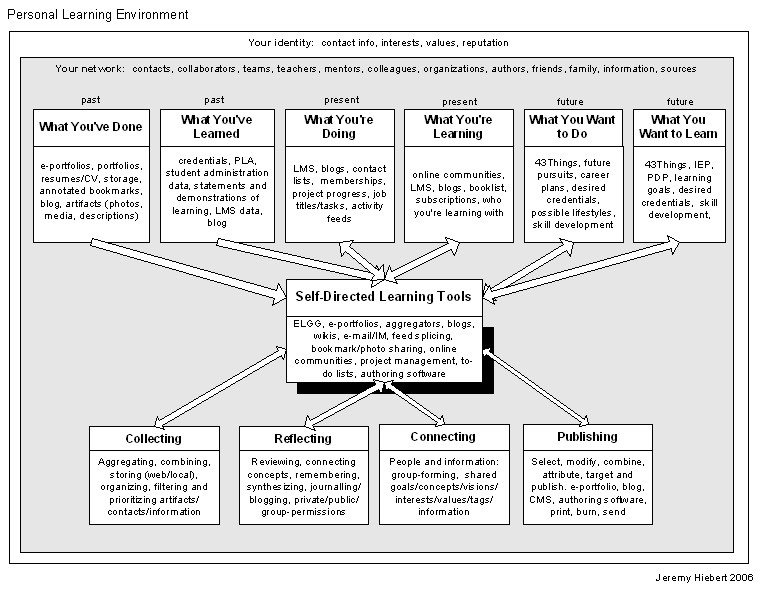
orking backwards to my original question what really is a PLE? I've got the general idea that it currently seems to be more of a concept then one simple thing. It is different for different people and is a collection of learning pieces, tools and experiences. Anything that assists or furthers you in learning is actually a part of your PLE. There doesn't seem to be one particular tool or formula that would be right for every person.

I found a diagram by Jeremy Hiebert that "works" for me in helping to visualize the whole idea. It's from Feb. 2006, so maybe there is something better that I haven't stumbled on yet.

It's really interesting to see a concept/tool being discussed and developed. I've never experienced anything like this and to read around through various posts discussing the notion is fascinating. One person comes up with one idea, another gives it a name, someone else draws a diagram. I'm excited to see where the topic will be in a year from now.

If I've misunderstood the terms I'd love to be corrected or pointed in a better direction (even if that is 1.0 of me).